Teams often have clear goals at the start of a quarter: launch a product, improve customer retention, increase sales, or deliver a major campaign.
The challenge is making sure everyday work actually supports those goals.
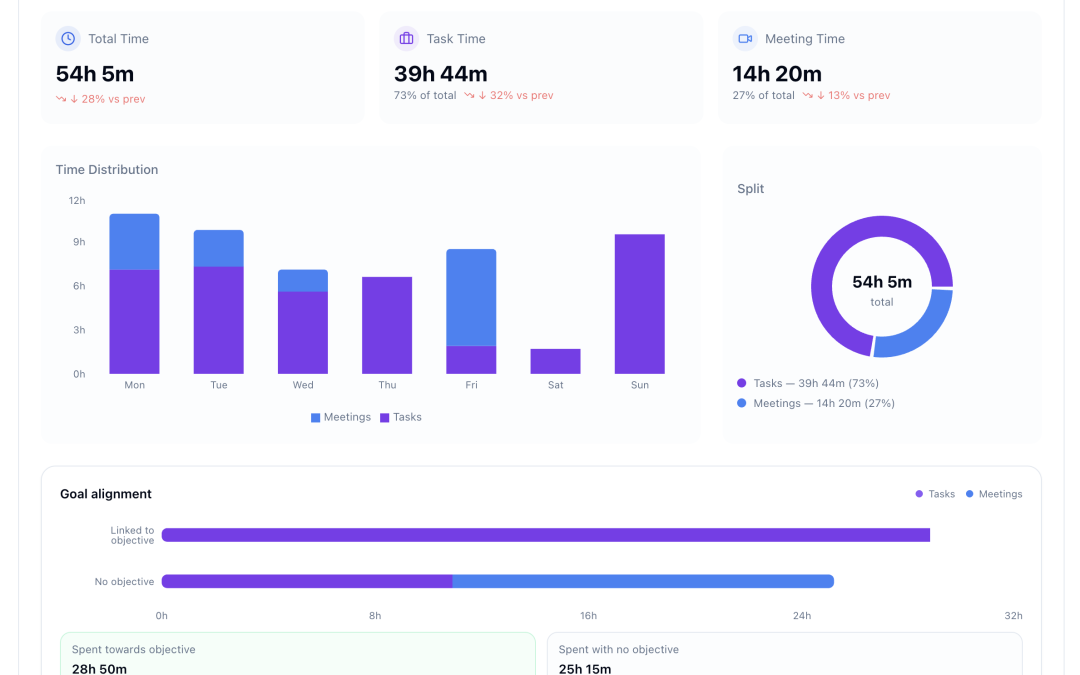
Without goal alignment, teams can complete dozens of tasks, attend meetings, and work long hours without knowing whether their effort is moving the business forward. M-Tracker’s Goal Alignment feature helps solve this by showing how tasks and time spent connect to the objectives that matter most.
What is goal alignment?
Goal alignment is the process of connecting daily tasks, projects, and team activity to wider business objectives.
For example, a marketing team may have an objective to increase product adoption. Tasks such as writing onboarding emails, producing product tutorials, and improving landing pages can all be linked to that objective.
When tasks are connected to goals, teams can see how everyday work contributes to measurable outcomes. When they are not connected, it becomes easier to spot work that may need more context, a different priority, or a new objective.
How M-Tracker helps teams create and align goals
M-Tracker helps users create objectives and goals for their work. Once an objective is in place, team members can link relevant tasks to it as they plan and complete their work.
The Goal Alignment feature then gives teams a clear view of:
- Time spent on tasks linked to objectives
- Time spent on tasks without an objective
- Which goals are receiving the most attention
- Where time may be drifting away from team priorities
This makes it easier to turn high-level business goals into practical daily work.
4 benefits of using Goal Alignment for teams
1. Keep team tasks connected to business goals
A well-written objective is helpful, but it only creates value when the team’s work supports it.
Goal Alignment helps teams connect individual tasks to strategic objectives. Instead of treating task lists as separate from company goals, everyone can see how their work contributes to a larger outcome.
This is especially useful for remote teams, cross-functional teams, and growing businesses where priorities can change quickly.
2. Identify work that is not linked to an objective
Every team has work that appears unexpectedly: urgent requests, quick fixes, meetings, follow-ups, and “small” tasks that somehow become a full afternoon.
M-Tracker helps highlight time spent on tasks with no linked objective. That does not mean the work is unimportant. It simply gives the team a chance to ask whether the task should be connected to an existing goal, added to a new objective, delegated, automated, or deprioritised.
It is a much better conversation than discovering at the end of the month that everyone was very busy and nobody knows why.
3. Improve team focus and prioritisation
When teams can see which objectives receive the most time and attention, they can make better decisions about priorities.
If a major goal is not receiving enough work, managers can remove blockers or reassign resources. If low-priority work is taking too much time, the team can address it before it becomes the unofficial full-time job.
Goal Alignment helps teams focus on what creates progress, not just what creates activity.
4. Create meaningful accountability
Goal Alignment is not about monitoring every task or making people explain every minute of their day.
It is about clarity. Team members can understand why a task matters, managers can see where support is needed, and leaders can recognise progress towards shared goals.
When everyone can connect their work to an objective, accountability becomes more constructive and less stressful.
How to get started with Goal Alignment in M-Tracker
Start by creating a clear objective in M-Tracker. Make it specific enough that your team can recognise which tasks support it.
Then encourage team members to link relevant tasks to that objective. Over time, use the Goal Alignment view to review where time is being spent and whether it matches your priorities.
A simple question can make a big difference:
Which objective does this task support?
If the answer is clear, link it. If there is no clear answer, that is useful information too.
Build a more focused team with M-Tracker
M-Tracker helps teams create objectives, connect tasks to goals, and understand how daily work supports business priorities.
With Goal Alignment, your team can spend less time guessing where effort is going and more time making measurable progress towards the goals that matter.

Work you can trust, without redoing it.
Your team gets feedback before work reaches you, or your client.
Copyright © 2020 – 2026 M-Tracker. All Rights Reserved. Privacy Policy