Teams see up to a 29% increase in revenue within 3 months.
Doing great work comes down to two things: what gets worked on, and how well it gets done. Most teams can’t see either one clearly. People stay busy, but nobody can say for sure whether the work moved a goal forward, or whether it was any good.
M-Tracker fixes both, at the task level, where revenue is actually made. It works alongside the tools you already use, and it doesn’t watch your team.
From “Did I work today?” to “Did my work matter?”
Before M-Tracker, most people start the day reactively, jump between tasks and messages, and end it tired but unsure what was accomplished.
After M-Tracker, the questions change:
- What did I complete today?
- Was it connected to something that matters?
- Was it done well?
Two things make that possible.
1. Accountability and transparency (without surveillance)
Every task can be linked to an objective.
When someone plans a task in M-Tracker, they can connect it to a goal, such as “Close 10 new accounts this quarter.” From then on, the task carries that context with it.
Everyone can see the connection.
Individuals see how their day supports the goals they’re responsible for. Teams see how their combined work adds up to the objective. Nobody has to guess, chase updates, or wait for a status meeting.
Unlinked work is visible too.
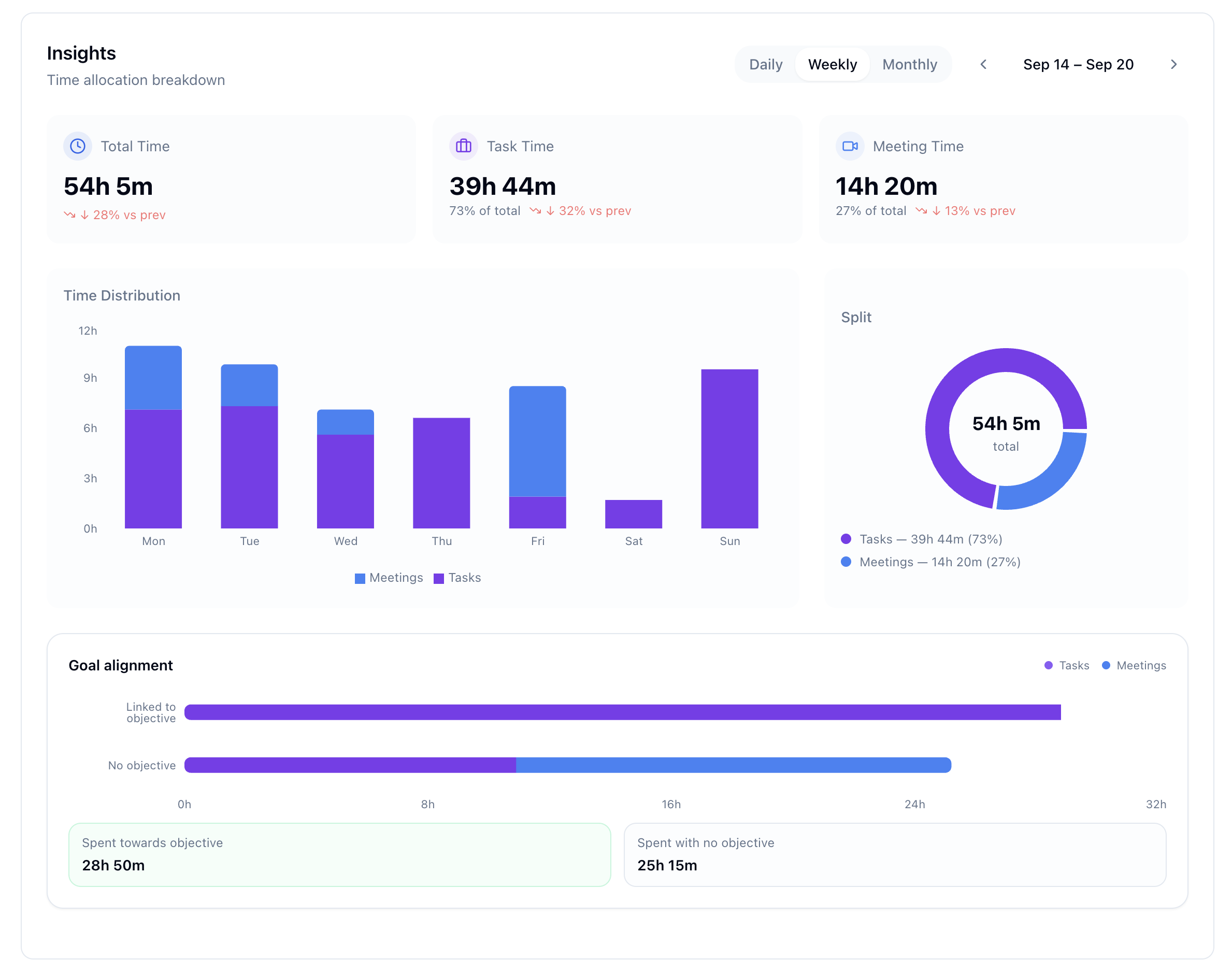
This is the part most tools skip. M-Tracker shows how much time went to work that isn’t tied to any objective, so it doesn’t stay hidden. In a typical weekly view, you can see the split at a glance: for example, 28 hours towards objectives and 25 hours with no objective.
That doesn’t mean unlinked work is bad. Some of it is necessary. But now you can ask better questions:
- Should this work be linked to a goal we forgot to set?
- Is this work worth the time it’s taking?
- Are we spending our best hours on what matters most?
Why this is not surveillance
M-Tracker doesn’t record screens, take screenshots, or log keystrokes. It doesn’t track how “active” someone looks. It only shows what people choose to plan, start and complete, and the objective it supports.
The point isn’t to catch anyone out. It’s to give people, and the teams they work in, the same clear picture. When employees can see how their own work connects to a goal, they take ownership of it. That’s accountability that builds trust, not fear.
2. Work quality intelligence
Finishing a task and finishing it well are not the same thing. Most teams only find out the difference days later, when a manager reviews the work or a customer complains.
M-Tracker gives that feedback instantly.
How it works
- When a task is created, it states what it’s meant to achieve: the goal or intent behind it.
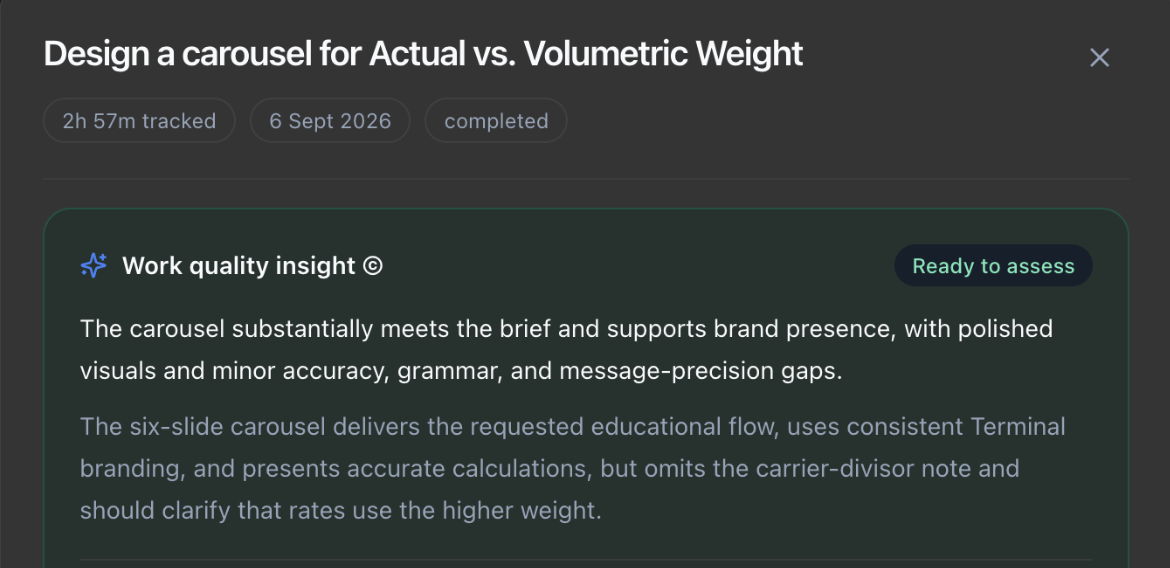
- When the work is done, M-Tracker reviews it against that intent.
- The person gets clear, immediate feedback on how well the task did what it set out to do, and what could be improved.
So the question stops being “Is it finished?” and becomes “Did it do its job?”
Why that matters
- Employees get feedback while the work is still fresh and easy to fix.
- Feedback goes to the employee first, before it reaches their manager, so it’s a chance to improve rather than a judgment.
- Managers spend less time on rework and back-and-forth reviews.
- Quality becomes something the whole team can measure, not just a feeling.
How the two work together
Accountability tells you that the right work is being done. Work quality intelligence tells you that it’s being done well.
Together, they close the gap that costs teams the most money: work that’s busy but pointless, or work that’s on target but poorly executed.
What this looks like in practice
- Sales: Every outbound call session is linked to a pipeline goal, and reviewed against what the session was meant to achieve. Reps know whether their effort is building revenue, and managers can see it too.
- Customer support: Time spent on each ticket type is visible, and each resolution is checked against what a good outcome looks like. Fewer repeat issues, happier customers, better retention.
- Marketing: Campaigns and content are tied to specific targets, so the team can say “we shipped 3 campaigns that supported our lead goal” instead of “we were working on it.”
- Product and engineering: Work in progress is visible, features are checked against what they were meant to deliver, and fewer half-finished items slip through.
Why teams see up to a 29% increase in revenue within 3 months
Because the work gets sharper:
- More of it is linked to goals that matter
- Less time is lost on work nobody can explain
- Quality problems are caught in hours, not weeks
- Output becomes measurable and execution becomes predictable
No micromanagement. No surveillance. No fake productivity.
Just clarity on what to work on, and instant feedback on how well it was done.

Work you can trust, without redoing it.
Your team gets feedback before work reaches you, or your client.
Copyright © 2020 – 2026 M-Tracker. All Rights Reserved. Privacy Policy